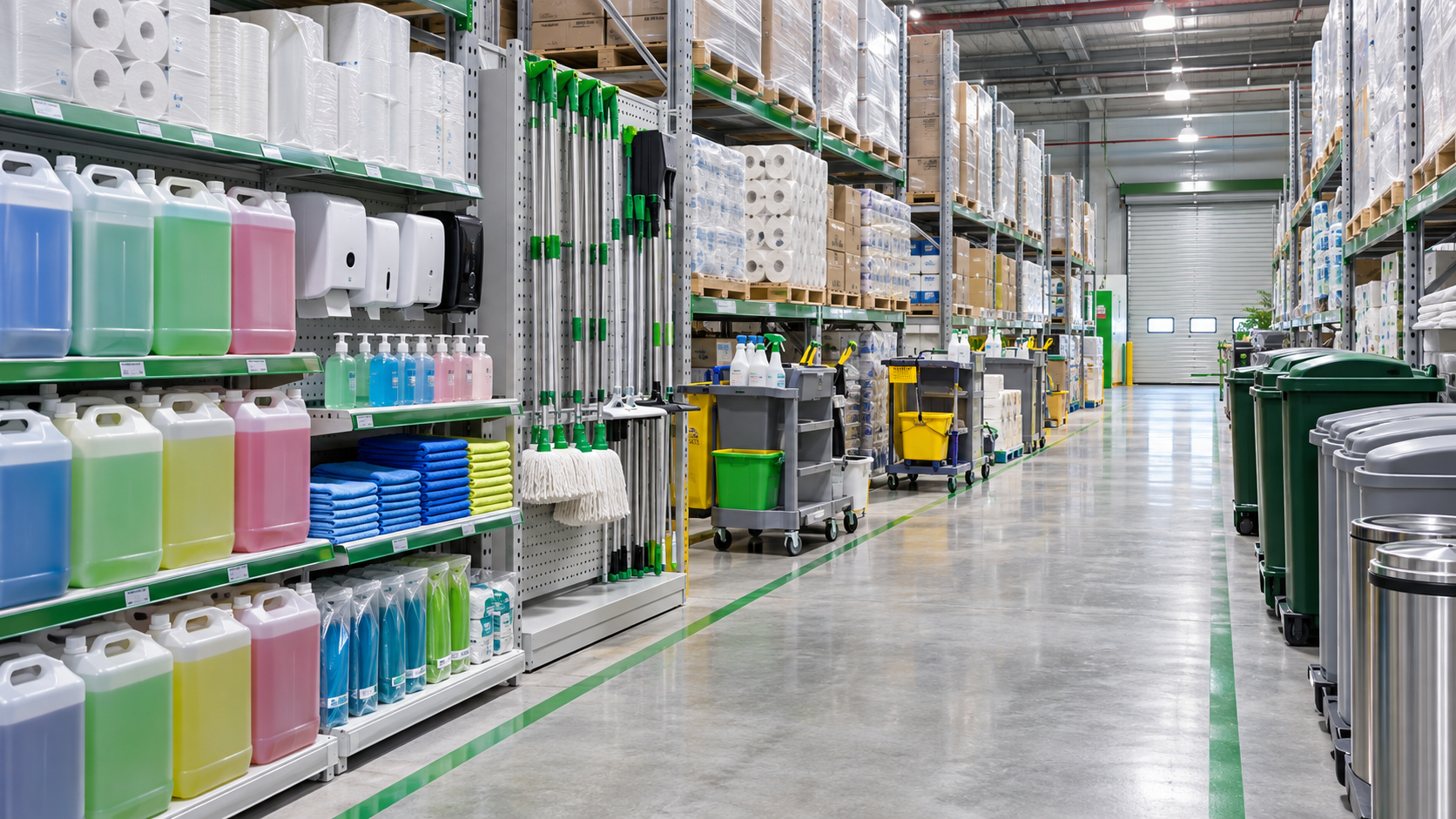
Buying janitorial supplies in the UAE in volume is a different exercise from buying them by the case. At low volume, the price per unit is most of the decision. At contract volume, the price per unit is one of six or seven variables, and the ones that cost real money are the ones that do not appear on a quotation: how often a line runs out, how much product is wasted through poor dilution control, how many separate deliveries your receiving team has to process, and how much stock degrades in an uncooled store room over a UAE summer. This guide is for procurement and facilities managers buying janitorial supplies for hotels, hospitals and clinics, commercial offices, transport and travel facilities, retail and multi-site portfolios across Dubai, Abu Dhabi and the Northern Emirates
What counts as janitorial supplies
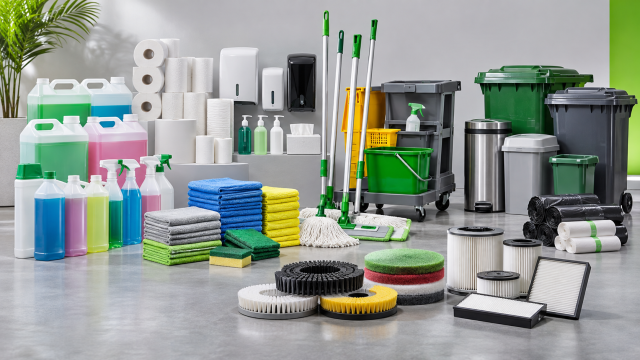
The term covers five recurring categories, and a bulk supply agreement should be built across all five rather than category by category:
● Cleaning chemicals – surface cleaners, degreasers, disinfectants, descalers, floor care products and dishwash chemicals.
● Tissue, dispensers and washroom consumables – toilet tissue, hand towel, jumbo rolls, hand soap, sanitiser, air care and the dispensers they feed.
● Cleaning tools and textiles – microfibre cloths, mops and mop systems, buckets and wringers, brushes, squeegees, trolleys and colour-coded sets.
● Waste management – bin liners by size and gauge, front- and back-of-house bins, segregation bins, sharps and clinical waste containers where relevant.
● Machine consumables – brushes, pads, squeegee blades, filters and bags for the equipment already on site. The categories interlock. Dispensers determine which tissue you can buy for the next five years. Floor surface determines which chemicals and which pads. Equipment on site determines which consumables. Buying them from separate suppliers is how facilities end up with jammed dispensers, pads that do not fit, and bin liners that split in the lift lobby.
Start from consumption, not from last year's order
Most supply lists in the UAE are built by repeating the previous order with an adjustment for complaints. That carries forward every error in it. The alternative takes a fortnight of counting and then works for years.
For each line, establish three numbers:
1. Monthly consumption at normal occupancy or headcount counted, not estimated.
2. Peak consumption, which in UAE hospitality and retail can run well above the annual average during high season and event periods.
3. The par level the stock position at which an order is triggered, set as peak consumption over the supplier’s lead time, plus a buffer.
Set par levels against peak rather than average and manage the surplus. A store room with four weeks of hand towel in it during a quiet month is a minor inventory cost. A hotel that runs out of hand towel during a peak weekend has a guest-facing failure, and the emergency purchase that follows is made at retail prices from whoever can deliver that afternoon.
Washroom consumables and bin liners warrant the deepest buffer of any category, because a run-out is immediately visible to guests, patients or staff and cannot be worked around.
Compare cost per use, not price per case
This is the single largest avoidable cost in bulk janitorial purchasing, and it applies differently to each category.
● Chemicals – compare the cost per litre of diluted, ready-to-use solution, not the cost per bottle of concentrate. A concentrate diluted at 1:100 and one diluted at 1:20 are not comparable products, and the cheaper bottle is frequently the more expensive solution. Where a supplier quotes a concentrate without a stated dilution ratio, the quotation is incomplete.
● Tissue – compare cost per sheet or per metre, and check sheet count per roll against the specification rather than the headline pack price. Compare like ply for like ply.
● Microfibre and mops – compare cost per wash cycle. A cloth that survives 300 industrial washes at twice the price of one that survives 80 is less than half the cost in use, and generates a quarter of the replacement orders.
● Bin liners – compare by gauge and dimension against the bin, not by price per roll. An under-gauged liner that splits costs the price of the liner, the price of the replacement, and the labour of cleaning up what it spilled.
● Machine consumables – compare cost per operating hour or per square metre cleaned. The pattern across all five: the cheapest purchase price is frequently the most expensive line in use, and the gap only becomes visible at volume.
The pattern across all five: the cheapest purchase price is frequently the most expensive line in use, and the gap only becomes visible at volume.
Contract supply or spot ordering
At volume, the question is whether to agree a supply schedule or keep ordering against requisitions.
A contract supply arrangement fixes rates for a defined period, commits the supplier to holding your high-volume lines as standing stock, and sets a delivery rhythm your receiving team can plan around. It costs flexibility: you are committed to the specification, and changing a line mid-term takes a conversation.
Spot ordering keeps every purchase open to the market. It costs predictability on both price and availability, consumes purchasing time on every order, and gives no supplier enough visibility of your volume to hold stock for you.
For recurring consumables that the building cannot operate without tissue, soap, liners, core chemicals contract supply is almost always the better position. For occasional capital items and specialist one-offs, spot purchasing is fine. Most well-run UAE facilities run both.
What to pin down in a supply agreement:
● The period rates are fixed for, and the notice and justification required for an increase.
● Which lines are held as standing stock in the UAE, named specifically rather than described as “our range”.
● Lead time by emirate, and whether a minimum order value applies below which delivery is charged or delayed.
● What happens on a stock-out: substitution rules, and whether an equivalent is sampled and approved before it ships.
● Notice period for discontinuation or reformulation, and whether transition stock is held.
● Volume tiers, payment terms and credit arrangements.
Delivery and storage across multiple sites
Two UAE-specific factors change bulk ordering here, and neither appears on a price list.
Multi-site delivery across emirates. Terms that are reliable in Dubai are often vague for Abu Dhabi, Sharjah and the Northern Emirates. If you run sites across emirates, confirm that quoted lead times and minimum order values apply to all of them, and establish whether each site can order against the central agreement directly or whether every requisition routes through head office. Site-level ordering against central rates is usually the arrangement that actually works, because it stops site managers buying locally at retail when something runs out.
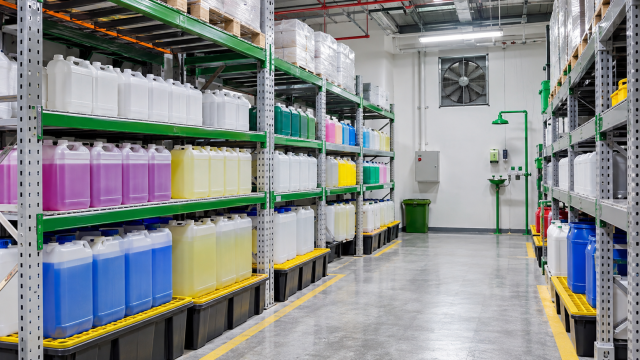
Heat and storage. Chemical concentrates stored in an uncooled back-of-house room through a UAE summer can degrade, separate or build pressure in the container. Before committing to a large drop quantity, check the product’s stated storage temperature range against the actual conditions in your store, and confirm shelf life from date of manufacture. Buying six months of a heat-sensitive concentrate to secure a volume price is a false economy if two months of it is unusable by September.
Practical storage requirements for a bulk janitorial agreement:
● A lockable, ventilated and shaded chemical store with secondary containment for concentrates.
● Shelf space calculated against par levels, not against the current order.
● Stock rotation on first-in-first-out, with dates visible without moving the stock.
● Dilution or dosing equipment at the point of use, so concentrate is not decanted by eye.
● Labelled decant bottles never unlabelled, and never a reused food or drink container.
Consolidate categories onto one account
Splitting chemicals, tissue, dispensers, tools, waste and machine consumables across five suppliers multiplies purchase orders, deliveries, invoices, delivery notes to reconcile and points of failure. It also weakens your commercial position, because no single supplier sees enough of your spend to sharpen a price against it.
Consolidation is worth most where the categories physically depend on each other: dispensers and the tissue that feeds them, machines and their consumables, colour-coded textiles and the system they belong to. Splitting is only worth the added complexity where one category has genuinely specialised requirements a single supplier cannot meet.
There is a procurement dimension to this too. If your organisation bids for UAE government or semi-government work, consolidating recurring consumable spend with a UAE ICV-certified supplier is one of the least disruptive ways to improve your own In-Country Value position, because nothing about the operation has to change. Blog 2: UAE ICV certification and procurement covers how supplier ICV feeds into a buyer’s score.
Building the list
If you want the zone-by-zone starting framework what to stock in guest rooms, public areas, washrooms, kitchens, floor care and waste work through the janitorial supplies checklist for hotels and FM companies and bring the completed list back with consumption figures against each line.
Daitona General Trading LLC has supplied janitorial supplies across the UAE since 1990 to hotels, hospitals, facility management companies, retail chains, offices and industrial facilities. We hold stock locally, deliver from Dubai and Abu Dhabi locations, and cover cleaning chemicals, commercial janitorial supplies, dispensers, aerosol and tissue, waste management and cleaning machines on a single account.
Request a quote with your site list and consumption figures and we will build a costed supply schedule against it.
Frequently Asked Questions
Where can I buy janitorial supplies in bulk in the UAE?
Bulk janitorial supplies in the UAE are bought either from suppliers who hold local stock or from traders who order against your purchase order. The distinction matters more than the price difference: a supplier holding stock in the UAE can deliver against a par level, while one ordering on receipt of your PO transfers the lead-time risk to you. Ask for warehouse locations, which of your high-volume lines are held as standing stock, and lead times to each emirate you operate in.
What are janitorial supplies?
Janitorial supplies covers the recurring products a building needs to be cleaned: cleaning chemicals, tissue and washroom consumables with their dispensers, cleaning tools and textiles such as microfibre, mops and trolleys, waste management products including bin liners and bins, and the consumable parts for cleaning machines such as brushes, pads and squeegee blades.
How much janitorial stock should a facility hold?
Set a par level per line rather than a blanket figure: peak consumption over the supplier's lead time, plus a buffer. Washroom consumables and bin liners should carry the deepest buffer because a run-out is immediately visible to occupants. Par levels set during a quiet month will fail during peak season, so base them on peak consumption and manage the surplus.
Is it cheaper to buy janitorial supplies in bulk?
Usually, but only when the comparison is made on cost per use rather than price per case. Compare chemicals as cost per litre of diluted solution, tissue per sheet, microfibre per wash cycle and liners by gauge against the bin. Bulk pricing on a product that performs poorly, wastes through poor dilution control, or degrades in storage before it is used is not a saving.
Do janitorial suppliers in the UAE deliver to all emirates?
Coverage varies, and terms that apply in Dubai often do not apply elsewhere. Confirm lead time, minimum order value and delivery charges for each emirate you operate in before signing a multi-site agreement. Daitona delivers across the UAE from its Dubai and Abu Dhabi locations with stock held locally.