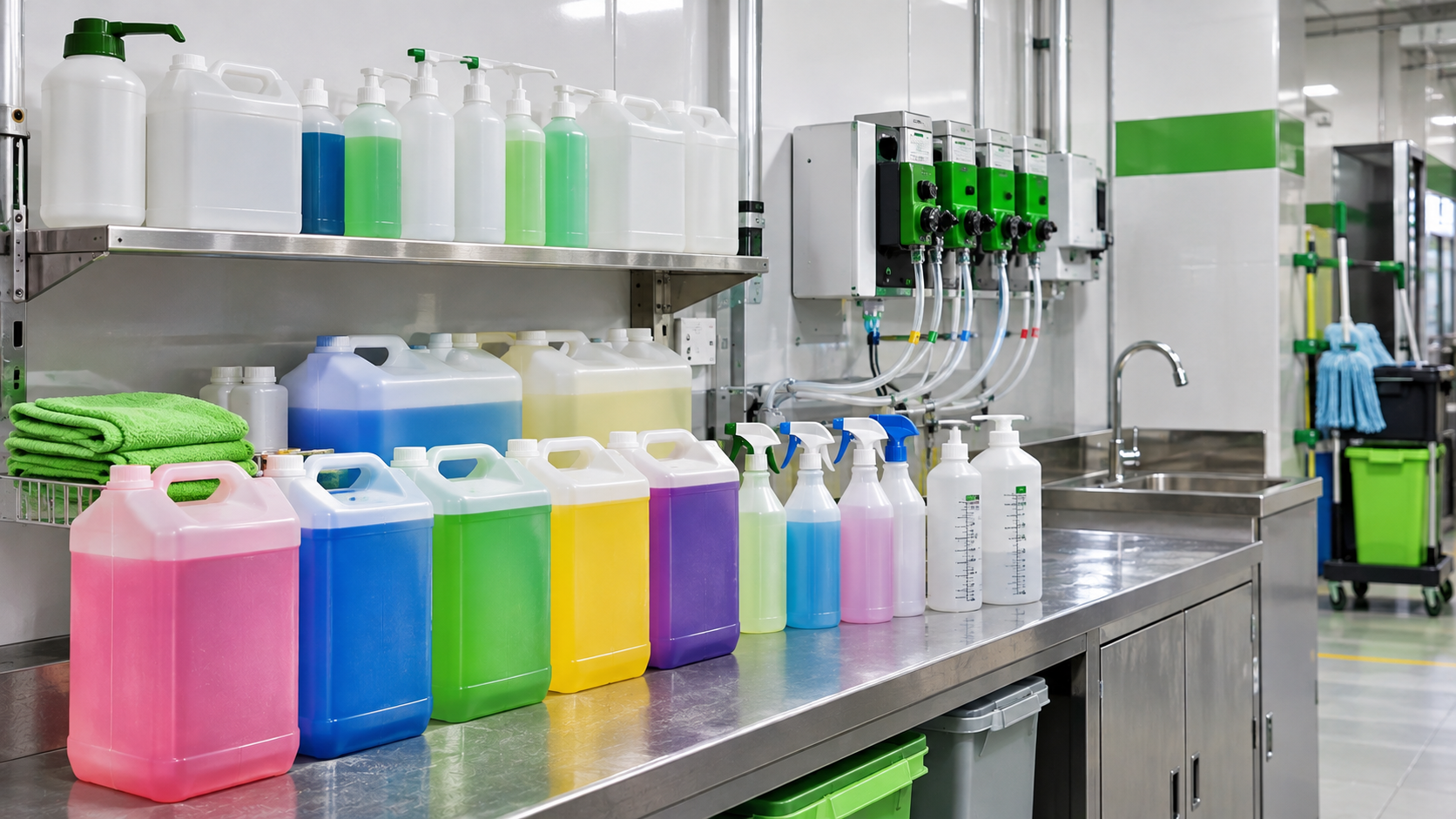
Cleaning chemicals are the one janitorial category where buying badly does more than waste money. The wrong product dulls a marble lobby floor permanently, damages the vacuum motor on a scrubber dryer, fails a food safety audit, or leaves a clinic’s high-touch surfaces looking clean without being disinfected.
This guide covers how to specify cleaning chemicals in the UAE for hotels, hospitals and clinics, commercial offices, food and beverage operations and facility management contracts what each category is for, how to compare products honestly, and what the regulatory position actually requires of a buyer.
The categories a facility actually needs
Most over-stocked chemical stores in the UAE hold fifteen products doing the work of seven. A complete specification for a typical commercial facility runs to roughly these categories:
| Category | What it does | Typical pH | Where it goes wrong |
|---|---|---|---|
| Neutral multi-surface cleaner | Daily cleaning of sealed floors, furniture and fittings | Neutral, around 7 | Substituted with an alkaline cleaner on polished stone |
| Washroom cleaner and descaler | Limescale, soap scum, sanitary ware | Acidic | Used on marble or terrazzo, which it etches |
| Heavy-duty degreaser | Kitchen hoods, ranges, extraction, workshop floors | Alkaline | Used at full strength on painted or soft metal surfaces |
| Disinfectant | Reducing microbial load on surfaces | Varies by chemistry | Applied and wiped off before its contact time has elapsed |
| Food-contact sanitiser | Food preparation surfaces and equipment | Varies | Not rated for food contact, or not rinsed as the label requires |
| Glass and mirror cleaner | Glazing, mirrors, stainless | Varies | Streaking from hard water rather than the product |
| Low-foam machine detergent | Scrubber dryers and automatic machines | Neutral to mildly alkaline | Replaced with a general-purpose cleaner |
| Floor care strippers, sealers, polish | Resilient floors that carry a finish | Strongly alkaline (stripper) | Applied to floors that should never be sealed |
The discipline is to hold one good product per category, trained and dosed correctly, rather than several overlapping ones. Every additional product is another dilution ratio for an operator to get wrong and another safety data sheet to file.
Match the chemical to the surface, not to the soil
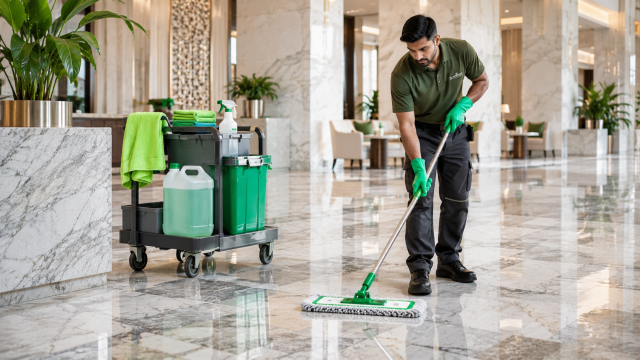
The most expensive chemical mistakes in UAE facilities are surface damage, and they are almost always a pH mismatch.
• Polished marble, terrazzo and natural stone – common in hotel and commercial lobbies across Dubai and Abu Dhabi. Requires neutral pH products only. Acidic washroom descalers etch the surface and alkaline degreasers dull the polish, and neither is reversible without re-polishing the floor.
• Ceramic and porcelain tile with grout – tolerates a wider pH range; the issue is mechanical rather than chemical, as soil sits in the grout line and needs agitation rather than a stronger chemical.
• Epoxy and resin-coated concrete – durable and tolerant of most products, but repeated use of strong solvents or high-pH strippers wears the coating at turning points and doorways.
• Vinyl and resilient flooring with a finish – the finish is the wear layer, not the floor. Strong alkalis strip it; once stripped, the floor needs re-sealing, not just re-cleaning.
• Stainless steel – chloride-based products cause pitting that looks like rust and cannot be polished out.
Before specifying any chemical for a new site, write down the surfaces by area. If a product’s label does not state compatibility with your largest surface, it is the wrong product regardless of price.
Dilution is where the money goes
Two facilities buying identical concentrate can have running costs that differ by a factor of three, and the difference is almost entirely dilution control.
Compare products on cost per litre of diluted, ready-to-use solution, never cost per bottle of concentrate. A product at a 1:100 dilution and one at 1:20 are not comparable; the cheaper container is frequently the more expensive solution in use. Where a supplier quotes a concentrate without stating its dilution ratio, the quotation is incomplete ask for it in writing.
Then control the dilution at the point of use:
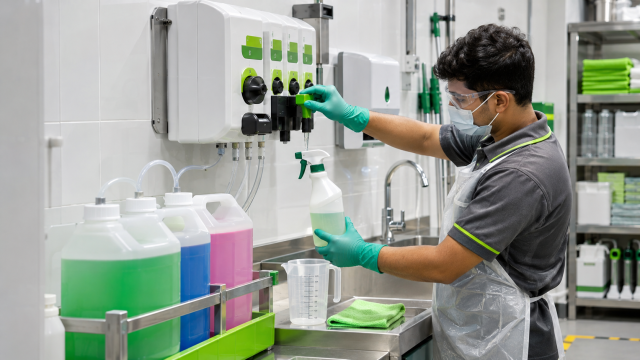
• Fit dosing or dilution equipment wherever a concentrate is decanted, so operators are not pouring by eye. Over-concentration is the normal failure, and it wastes product, leaves residue and can damage surfaces.
• Label every decant bottle with the product and the dilution. Never leave one unlabelled and never reuse a food or drink container.
• Put the dilution ratio on a chart in the chemical store and in each cleaning cupboard, in the languages your cleaning team actually reads.
• Re-train on dilution when staff turn over. It is the first discipline to decay.
Hard water changes the specification
UAE supply water is generally hard, and this is not a minor adjustment to a European or North American specification it changes which products work.
• Limescale builds quickly on taps, glass, shower screens, sanitary ware and inside dishwash machines, so descaling is a routine consumable line rather than an occasional purchase.
• Dishwash detergent and rinse aid must be specified for hard water. The wrong product shows up as clouded glassware and a stream of guest complaints that looks like a cleaning problem and is actually a chemistry problem.
• Some detergents lose effectiveness in hard water as the surfactants bind to dissolved minerals, which operators compensate for by over-dosing. Specify products formulated for the local water rather than letting the team fix it with volume.
• Glass cleaning streaks are frequently the water, not the cleaner.
The compliance position: what a buyer should actually check
This is the part most cleaning chemical pages leave out, and it is the part a procurement team is accountable for.
Product registration
Detergents and disinfectants sold in Dubai must be registered with Dubai Municipality before being placed on the market. The Municipality’s Technical Guidelines for Detergents set the scope and process, and the categories named in it include industrial detergent chemicals, institutional detergent chemicals, professional use detergents and hotel amenity detergents which is to say, essentially everything a commercial facility buys. Registration is handled through the Municipality’s consumer product registration service, applicants must be licensed in Dubai for detergent-related activity, and products may be subjected to chemical testing to verify safety, efficacy and quality. Registration certificates are issued for a defined term and must be renewed before expiry.
At federal level, the Ministry of Industry and Advanced Technology (MoIAT), which absorbed the functions of the former Emirates Authority for Standardization and Metrology (ESMA), oversees the technical regulations and conformity certification that apply alongside municipal registration.
What this means for you as a buyer.
You are not the registrant your supplier or the manufacturer is. But if an auditor or a municipal inspection asks whether the chemicals in your store are registered products, “the supplier said so” is not an answer. Before awarding a chemicals contract, ask for the registration reference for each product you are buying, and check that the entity named on it is the entity invoicing you. Unregistered product is a risk you inherit at the point of delivery.
Requirements differ by emirate and are revised periodically, so confirm the current position with Dubai Municipality or the relevant local authority for your sites rather than relying on a supplier’s summary including this one.
Safety data sheets
A current safety data sheet must be held on site for every chemical in use, accessible to the people using it rather than filed in an office nobody can reach at 2am. Check that the sheet matches the product actually delivered: reformulations happen, and a sheet for the previous formulation is not compliant. Sheets should be available in a language your cleaning team can read.
This is the single most common finding in UAE facility audits on the chemical side, and it is entirely avoidable.
Storage
Chemical stores require ventilation, shade, secondary containment for concentrates and a spill kit sized to the largest volume held. Heat is the UAE-specific factor: concentrates stored in an uncooled back-of-house room through summer can degrade, separate or build pressure in the container. Check each product’s stated storage temperature range against the real conditions in your store before committing to a bulk drop quantity.
Incompatible chemicals must be separated in storage. Acids and chlorine-based products in particular should never be stored where a spill could bring them into contact, as the reaction produces chlorine gas.
Personal protective equipment and training
PPE must match the chemicals held, not the general idea of cleaning: gloves rated for the specific chemistry, eye protection where splash risk exists during decanting, and aprons where concentrates are handled. Specify the PPE at the same time as the chemicals, from the same supplier where possible, so the match is deliberate rather than approximate.
Operator training on dilution, contact time and which product goes on which surface is what converts a good specification into a clean building. Ask whether your supplier provides it and whether refresher training is available as staff turn over.
Disinfectant claims and contact time
A disinfectant only disinfects if it stays wet on the surface for its stated contact time. Applying it and wiping it off immediately cleans the surface and achieves very little else. Check the label for the contact time, confirm the surface will stay visibly wet for that long in air-conditioned conditions, and build the time into the cleaning procedure rather than hoping for it.
For food preparation areas, confirm the sanitiser is specified for food contact and follow the label on whether a potable rinse is required. For healthcare settings, disinfectant selection is a clinical decision as much as a procurement one ,see Blog 8: hospital and clinic cleaning supplies.
Machine compatibility
Scrubber dryers and automatic scrubbing machines are engineered for low-foam detergents. A general-purpose or high-foam floor cleaner carries foam over into the recovery tank, triggers the float shut-off and, over time, damages the vacuum motor a repair that costs considerably more than the chemical saved. Always confirm the detergent is specified for automatic scrubbing machines, and see how to choose a commercial floor scrubber for the machine side of the same decision.
Specifying with a supplier
If you can supply your surfaces by area, the soils you are dealing with, the machines on site and any food safety or clinical requirements, most of the chemical specification work is done.
Daitona supplies cleaning chemicals across the UAE from its Dubai and Abu Dhabi locations, holds stock locally, and provides documentation, safety data sheets and operator support for the products it supplies. Samples and site trials are available chemicals perform differently against different soils, surfaces and water, and a trial on your own floors tells you more than a specification sheet.
Request a quote with your surface and soil details and we will build a chemical specification against it.
Frequently Asked Questions
Do cleaning chemicals need to be registered in the UAE?
Detergents and disinfectants must be registered with Dubai Municipality before they are placed on the Dubai market, under the Municipality's technical guidelines for detergents, and comparable requirements apply in other emirates. The scope covers industrial, institutional and professional-use detergents as well as disinfectants. Registration is the supplier's or manufacturer's obligation, but buyers should ask for the registration reference for each product and confirm it matches the entity invoicing them. Confirm the current requirements with the relevant local authority, as they are revised periodically.
What cleaning chemicals does a commercial facility need?
A typical commercial facility needs a neutral multi-surface cleaner, an acidic washroom cleaner and descaler, an alkaline heavy-duty degreaser, a surface disinfectant, a food-contact sanitiser where food is handled, a glass cleaner, a low-foam detergent for automatic scrubbing machines, and floor care products where the floor carries a finish. Holding one well-specified product per category beats holding several overlapping ones.
How do I compare cleaning chemical prices in the UAE?
Compare the cost per litre of diluted, ready-to-use solution rather than the cost per container of concentrate. A product diluted at 1:100 and one diluted at 1:20 are not comparable, and the cheaper bottle is frequently the more expensive solution in use. If a supplier quotes a concentrate without stating the dilution ratio, the quotation is incomplete.
Why does hard water matter when choosing cleaning chemicals in the UAE?
UAE supply water is generally hard, so limescale builds quickly on taps, glass, sanitary ware and inside dishwash machines, and some detergents lose effectiveness as surfactants bind to dissolved minerals. Descalers become a routine consumable rather than an occasional purchase, and dishwash detergent and rinse aid should be specified for hard water — clouded glassware is usually a chemistry problem rather than a cleaning one.
Can I use any floor cleaner in a scrubber dryer?
No. Scrubber dryers require low-foam detergents formulated for automatic scrubbing machines. High-foam general-purpose cleaners carry foam into the recovery tank, trigger the shut-off float and can damage the vacuum motor over time. Always confirm the product is rated for machine use.
What chemicals are safe for marble floors?
Neutral pH products only. Acidic washroom descalers etch polished marble and terrazzo, and alkaline degreasers dull the finish. Neither is reversible without re-polishing the floor, which is why hotel and commercial lobbies with natural stone need a dedicated neutral cleaner and a colour-coded set that cannot be confused with the washroom kit.