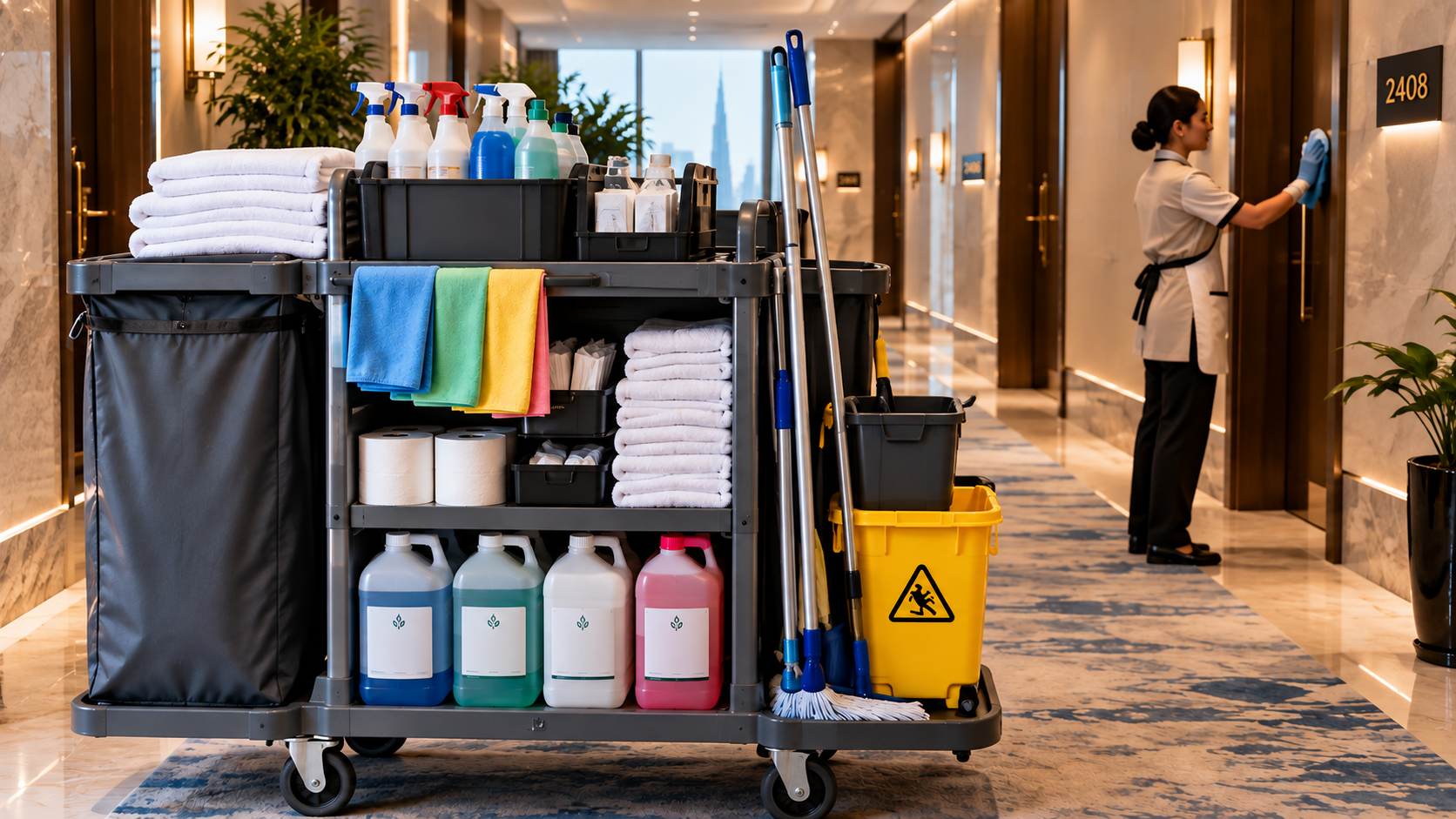
Whether you are opening a new property, mobilising an FM contract or rebuilding a supply list that has grown untidy over several years, the same problem tends to appear: the list is built from what was ordered last month rather than from what the building actually requires. Gaps show up during the first inspection, and duplicate products accumulate in the store room.
The checklist below is organised by zone, which is how buildings are actually cleaned, and is intended as a starting framework for hotels and FM contractors operating in Dubai and across the UAE.
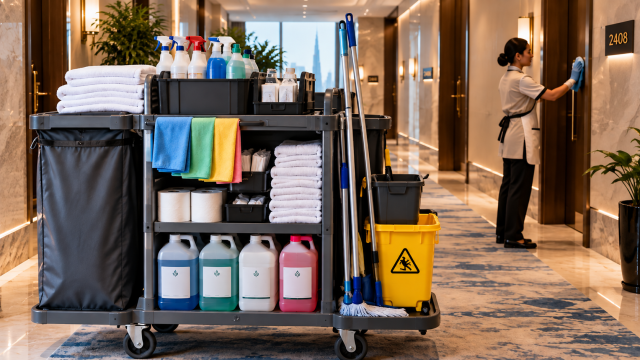
How to use this checklist ?
Work through it zone by zone against your own site. For each line, record three things: the product, the monthly consumption estimate, and the par level at which you reorder.
A checklist without par levels is a wish list, not a procurement plan.
Guest rooms and housekeeping
- Housekeeping trolleys with linen bag, waste bag and caddy provision
- Microfibre cloths in a colour-coded set, sized for room use
- Glass and mirror cleaner
- Bathroom and limescale remover essential given UAE water hardness
- Neutral multi-surface cleaner for furniture and fittings
- Toilet bowl cleaner and bowl mops
- Air freshener or aerosol dispensing system
- Guest amenity and tissue replenishment stock
- Hand-held vacuum or upright vacuum suited to the floor covering
- Spray bottles, triggers and labelling for decanted products
Lobbies, corridors and public areas
- Entrance matting the single highest-return item on this list, since most soil entering a building arrives on footwear
- Dust control mops and frames for hard floors
- Neutral floor cleaner safe for marble and polished stone
- Stainless steel cleaner for lift doors, handrails and signage
- Upholstery and carpet spotting kit
- Wet floor caution signs in sufficient quantity and in Arabic and English
- Cordless or low-noise vacuums for daytime cleaning in guest-facing areas
- Glass cleaning kit with extension pole for high glazing
Washrooms
Washrooms generate more guest complaints than any other zone, and almost all of them trace back to consumable run-out rather than cleaning quality.
- Hand soap and dispensers, with a decision made on refill versus cartridge systems
- Hand sanitiser and dispensers
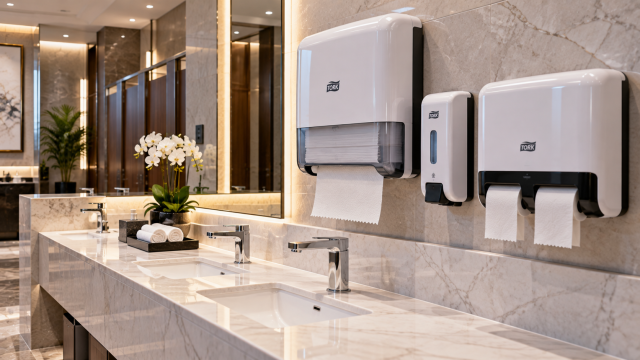
- Paper towel or jumbo roll dispensers, matched to the tissue product actually being purchased
- Toilet tissue and dispensers
- Sanitary waste bins and liners
- Washroom disinfectant and descaler
- Air care system with a defined refill cycle
- Colour-coded cloths and mops reserved exclusively for washrooms
- Drain maintenance products
Check dispenser and consumable compatibility before you buy either.
Mismatched dispensers and refills are one of the most common and most expensive stock problems in hospitality, and the cost surfaces as jammed dispensers and wasted tissue rather than as a line on an invoice.
Kitchens and food and beverage areas
Kitchen cleaning is governed by food safety requirements, so product selection here should be documented and auditable.
- Heavy-duty degreaser for hoods, ranges and extraction
- Food-safe surface sanitiser with a stated contact time
- Dishwash detergent and rinse aid matched to the machine and to local water hardness
- Oven and grill cleaner
- Colour-coded cloths, brushes and mops used exclusively in food areas
- Chemical dilution or dosing system to prevent over-concentration
- Safety data sheets held on site for every chemical in use
- Gloves, aprons and eye protection appropriate to the chemicals stocked
Floor care
- Scrubber dryer sized to the largest hard-floor area, with spare brushes, pads and squeegee blades
- Single disc machine for deep cleaning, polishing or carpet bonnet work
- Wet and dry vacuum for spill response
- Carpet extraction equipment, owned or contracted in
- Low-foam detergent specified for automatic scrubbing machines
- Mop trolleys with wringer, plus flat-mop system for finishing
- Floor sealer and polish where the surface requires it
Waste management and segregation
- Front-of-house bins appropriate to the property’s design standard
- Back-of-house waste trolleys and bulk containers
- Segregation bins where the property operates a recycling stream
- Bin liners in the correct sizes and gauges an area where under-specifying gauge causes daily failures
- Waste compaction or baling equipment on larger sites
- Bin cleaning and deodorising products
Back of house, storage and compliance
- A lockable, ventilated chemical store with secondary containment for concentrates
- Dilution station or dosing equipment with clear operator instructions
- Labelled decant bottles never unlabelled, and never reusing a food or drink container
- Safety data sheets filed and accessible
- Personal protective equipment matched to the chemicals held
- Spill kit appropriate to the largest chemical volume stored
- Colour-coding chart displayed in the store and in each cleaning cupboard
Four UAE-specific factors that change the list
A supply list copied from a European or North American template will underperform here. Four local conditions materially affect product selection.
Water hardness
UAE supply water is generally hard, and limescale builds quickly on taps, glass, shower screens and in dishwash machines. Budget for descaling products as a routine consumable rather than an occasional purchase, and check that your dishwash detergent and rinse aid are specified for hard water the wrong product shows up as clouded glassware and constant guest complaints.
Dust and sand ingress
Fine dust is a constant load on every building in the region, and it drives two decisions: heavier investment in entrance matting than a temperate-climate specification would suggest, and dust control mopping as a daily routine rather than a weekly one. Vacuum filter replacement cycles will also be shorter than the manufacturer’s stated interval.
Heat and cooling loads
Chemical storage areas need to be genuinely ventilated and shaded. Concentrates stored in an uncooled back-of-house room through a UAE summer can degrade, separate or build pressure in the container. Check product storage temperature ranges before deciding where the store room goes.
Seasonal occupancy swings
Hotel occupancy, mall footfall and event-driven demand vary sharply across the year in Dubai. Consumption of washroom consumables, bin liners and hand hygiene products can move by a wide margin between peak and low season. Par levels set during a quiet month will fail during peak, so base them on peak consumption and manage the surplus rather than the reverse.
Set up colour coding before you order
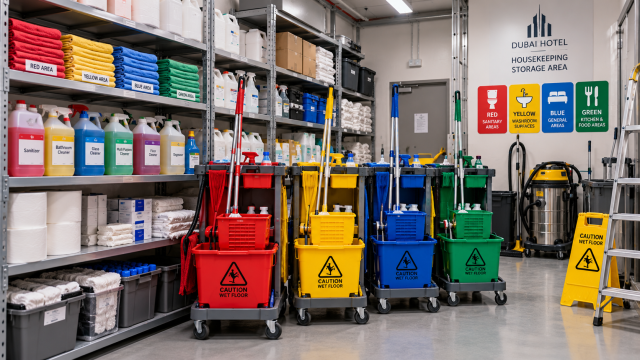
A four-colour system is standard across UAE hospitality and FM operations and prevents cross-contamination between zones. The widely used convention is red for sanitary areas, yellow for other washroom surfaces, blue for general and public areas, and green for kitchens and food handling.
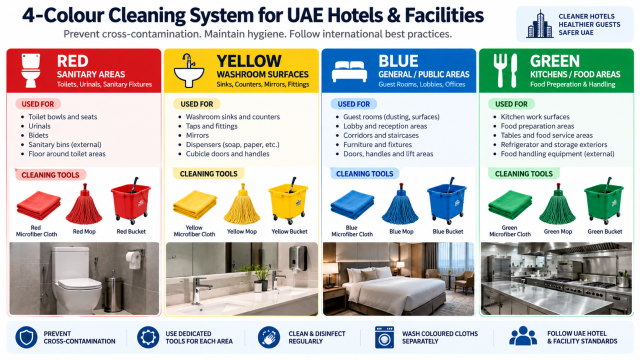
Decide the system first, then order cloths, mops, buckets, brushes and trolleys to match it. Retrofitting colour coding onto stock already purchased is far more expensive than specifying it at the outset.
Set par levels and consolidate suppliers
Once the list is built, two decisions determine whether it works in practice.
The first is par levels. For each consumable, agree the minimum stock at which an order is triggered, based on realistic consumption and supplier lead time, with a buffer for peak occupancy. Washroom consumables and bin liners should carry a deeper buffer than anything else, because running out of them is immediately visible to guests.
The second is supplier consolidation. Splitting chemicals, tissue, dispensers, machines and consumables across five suppliers multiplies your administration, fragments your delivery schedule and weakens your negotiating position. A supplier who can cover the full list from one account, with one delivery and one invoice, removes a significant amount of daily friction from the operation.
Building your supply list
Daitona has supplied hotels, facility management companies, retail chains and industrial facilities across the UAE since 1990, from cleaning chemicals and commercial janitorial supplies to dispensers, aerosol and tissue systems, waste management equipment and commercial cleaning machines.
Our showroom in Abu Hail, Dubai holds the range for inspection, with a second location in Musaffah, Abu Dhabi. Request a quote with your site list and we will build a costed supply schedule against it.
Frequently Asked Questions
What cleaning supplies does a hotel need?
A hotel needs supplies across six zones: guest rooms and housekeeping, public areas, washrooms, kitchens and food and beverage, floor care, and waste management. Within those, the recurring categories are cleaning chemicals, tissue and dispenser consumables, microfibre and mopping systems, bin liners and machine consumables. Building the list zone by zone rather than by product category is the most reliable way to avoid gaps.
What is the standard colour coding system for cleaning in the UAE?
The widely used convention across UAE hospitality and facility management is red for sanitary areas such as toilets and urinals, yellow for other washroom surfaces including basins and mirrors, blue for general and public areas, and green for kitchens and food handling areas. The system should be agreed before purchasing cloths, mops, buckets and trolleys so that stock matches it from the start.
How often should a hotel reorder janitorial consumables?
Rather than fixing a calendar cycle, set a par level for each item — the minimum stock at which an order is triggered — based on actual consumption plus supplier lead time and a buffer for peak occupancy. Washroom consumables and bin liners warrant a deeper buffer than other categories because a run-out is immediately visible to guests.
Should we buy cleaning supplies from one supplier or several?
Consolidating with one supplier who can cover chemicals, consumables, dispensers, machines and servicing reduces administration, simplifies delivery scheduling and strengthens your commercial position at negotiation. Splitting across multiple suppliers is generally only worth the added complexity where one category has genuinely specialised requirements that a single supplier cannot meet.
Do you deliver janitorial supplies across Dubai and the UAE?
Yes. Daitona delivers cleaning products, janitorial supplies and equipment across the UAE from its Dubai and Abu Dhabi locations, with stock held locally for prompt fulfilment. The Dubai showroom in Abu Hail is open for customers who want to inspect products before committing to a supply schedule.
Send us your site list and we will build a costed supply schedule
Related: browse the categories in this checklist Cleaning Chemicals, Commercial Janitorial Supplies, Dispensers, Aerosol & Tissue, Waste Management, Cleaning Machines