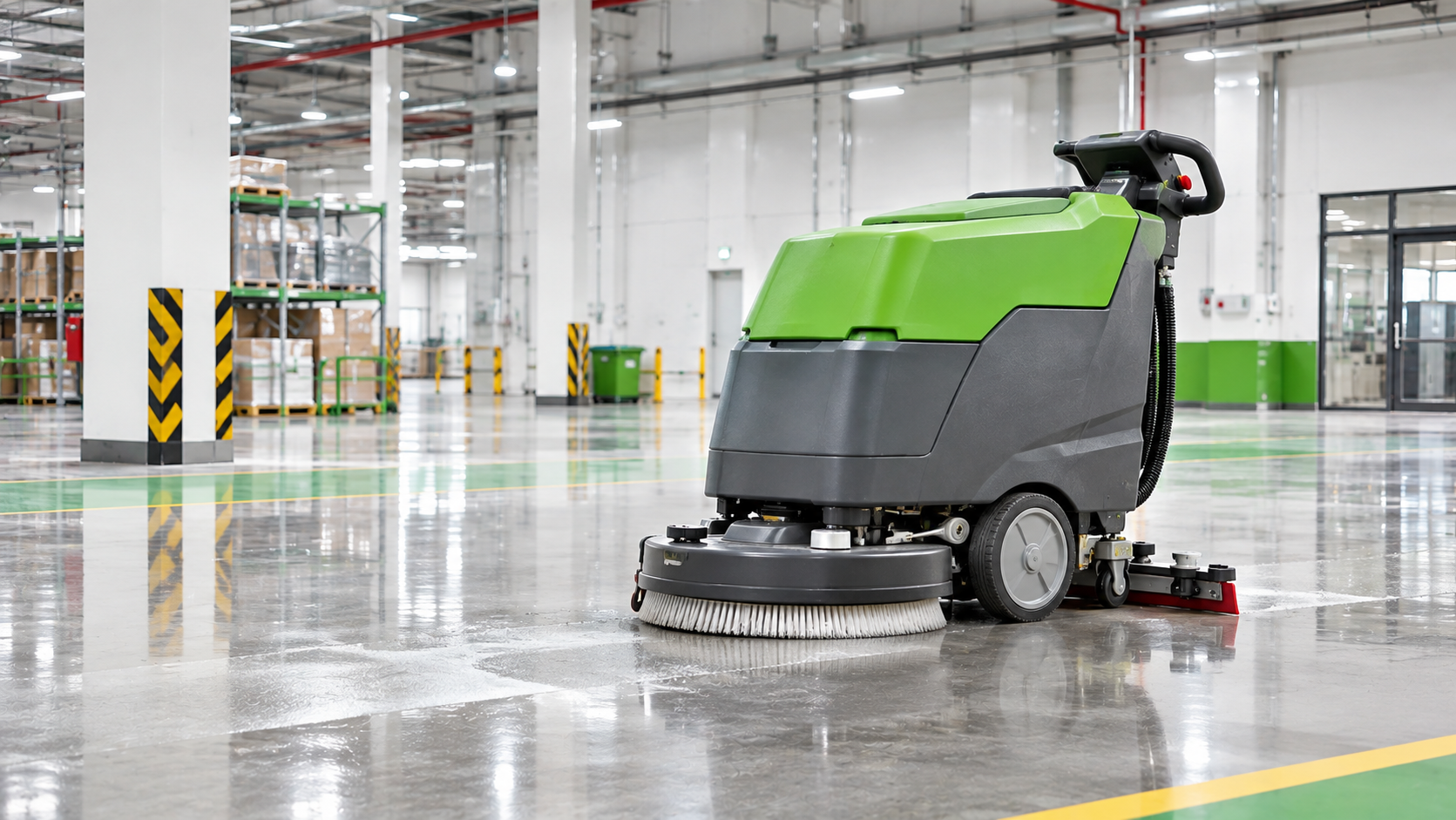
Cleaning equipment is the part of a janitorial budget that gets specified from a catalogue and regretted on site. The common failure is not buying a bad machine it is buying a good machine for the wrong building: a ride-on scrubber for a floor plan it cannot turn in, a single large machine for a site with no service lift, or a specification copied from a European facility into a building that takes in desert dust every time a door opens.
This guide works through the main classes of commercial cleaning equipment, then what each facility type in the UAE actually needs, and the running costs that decide whether a purchase was a good one.
The Equipment Classes
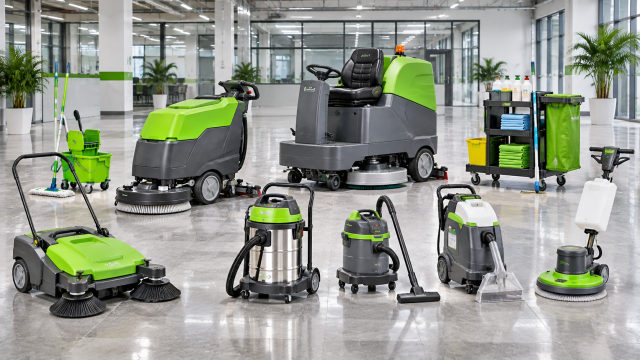
| Equipment | What it is for | Typical UAE application |
|---|---|---|
| Scrubber dryer (walk-behind) | Washes and dries hard floors in one pass | Hotels, offices, clinics, retail, mid-size warehouses |
| Scrubber dryer (ride-on) | Same, for large open floors | Logistics, car park decks, exhibition halls, large retail |
| Single disc machine | Deep cleaning, polishing, carpet bonnet work | Hotel lobbies, stone and resilient floors |
| Sweeper | Dry debris and dust on large hard floors | Warehouses, yards, car parks, loading areas |
| Dry vacuum | Carpet and hard floor dust | Offices, hotel rooms, corridors |
| Wet and dry vacuum | Spill response and wet pick-up | Everywhere, as a spill-response asset |
| Carpet extractor | Deep cleaning carpet and upholstery | Hotels, offices, conference venues |
| High-pressure washer | External hard surfaces, bins, loading bays | Car parks, service yards, waste areas |
| Steam cleaner | Chemical-light sanitising of fittings | Healthcare, kitchens, washrooms |
| Mop and trolley systems | Daily manual cleaning and transport | Every facility, in colour-coded sets |
| Entrance matting | Stopping soil at the door | Every facility - the highest-return item here |
Entrance matting deserves its place on an equipment list rather than a consumables one. Most soil entering a UAE building arrives on footwear, and matting that stops it at the door reduces the load on every other machine downstream. It is the cheapest line on this table and the one with the clearest return.
What each facility type needs
Hotels
Mixed surfaces, guest-facing constraints and a cleaning window that never fully closes. The specification priorities are low-noise and cordless machines that can run during the day in guest areas, a neutral-safe single disc for stone lobbies, carpet extraction for rooms and corridors, and compact walk-behind scrubbers that fit in service lifts and through guest-room doorways. Wet floor caution signs in Arabic and English, in quantity.
Hospitals and clinics
Equipment here is part of the infection-control system, not just the cleaning operation. Priorities are machines that can be cleaned down and disinfected between zones, dedicated equipment per risk zone so nothing crosses from a sanitary area into a clinical one, HEPA-filtered vacuums where airborne particulate matters, low-noise machines for patient areas, and steam equipment where chemical use needs reducing. Colour coding extends to machines and not only to cloths. See Blog 8 for the full healthcare picture.
Commercial offices
Largely carpet and sealed hard floor, cleaned outside working hours, usually by an FM contractor. Priorities are dry vacuums suited to the carpet specification, a compact scrubber dryer for core and washroom hard floors, carpet extraction on a planned cycle rather than reactively, and glass equipment with extension poles for internal glazing. Multi-tenant buildings need to settle who owns the equipment landlord or contractor before the contract starts, because it determines who pays for servicing.
Airports, transport hubs and travel facilities
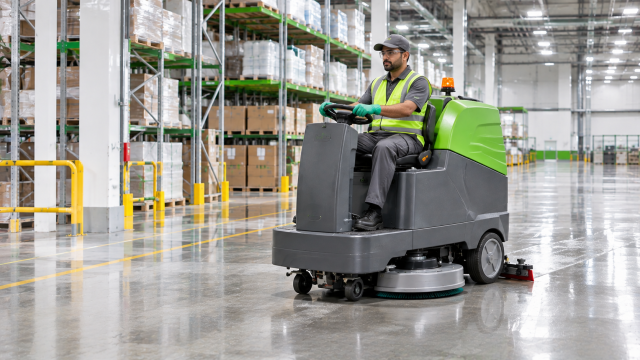
Continuous operation, very large hard-floor areas, heavy footfall and no real cleaning window. Priorities are ride-on scrubber dryers with runtime that covers a full shift, sweepers for debris, battery capacity and charging infrastructure planned as a system rather than per machine, and enough spare machines or loan cover that a breakdown does not take an area out of service. Noise and visibility in public areas matter as much as productivity.
Retail and shopping centres
Long trading hours, polished and tiled floors, and seasonal footfall swings. Priorities are machines that are safe and quiet to run during trading, compact units for back-of-house and food courts, and consumable stock planned against peak season rather than average.
Warehousing, logistics and industrial
Large, open, abrasive floors. Priorities are ride-on scrubbers and sweepers sized to the area, dust control as a daily routine, equipment rated for the floor’s abrasiveness, and consumable budgets that reflect faster wear on bare or power-floated concrete.
Across all of them, the sizing decision for scrubber dryers comes down to floor area against cleaning window, and the layout decides walk-behind against ride-on. How to choose a commercial floor scrubber in the UAE works through that specification in detail.
The running cost is the real cost
Over a five-year life, the purchase price of a commercial cleaning machine is often less than half of what it costs. Build any equipment comparison on:
Consumables – brushes, pads, squeegee blades, filters and bags, replaced on a cycle that varies sharply with how abrasive the floor is.
Batteries – conventional lead-acid sets typically need replacement within the machine’s service life; lithium costs more up front and usually lasts longer. For continuous operations, factor in either fast charging or a spare battery set.
Detergent – compared as cost per litre of diluted solution, not per bottle.
Servicing – planned maintenance plus the cost of unplanned breakdowns, including the labour of cleaning manually while a machine is out.
Labour – the one that dwarfs the others. A machine that halves cleaning hours on a large site repays itself far faster than one bought purely on price.
Service and spare parts in the UAE
This is where equipment purchases go wrong, and it has nothing to do with the machine. A scrubber dryer or industrial vacuum is a working vehicle with motors, pumps, seals, batteries and wear parts. It will need service.
Before committing, establish:
Whether the supplier employs technicians in the UAE or a fault means waiting on an overseas principal.
Which spare parts are held in local stock, named specifically.
The realistic response time for a breakdown call, and whether a service contract is available.
Whether a loan or replacement machine is provided if a repair runs long.
Who trains operators, and whether refresher training is available as staff turn over.
A slightly more expensive machine backed by UAE-based service and stocked parts is almost always the better commercial decision. A cheaper unit with no support behind it is not cheaper it is a machine with an unfunded liability attached. Daitona provides cleaning machine servicing across the UAE for the equipment it supplies.
Two UAE conditions that change the specification
Dust and sand. Fine dust is a constant load on every building in the region. It means heavier investment in entrance matting than a temperate-climate specification suggests, dust control mopping as a daily rather than weekly routine, and vacuum filter replacement cycles shorter than the manufacturer’s stated interval. Budget filters accordingly.
Heat. Ride-on machines reduce operator fatigue materially over a full shift in UAE summer conditions, which is a safety argument as much as a productivity one. Battery storage and charging areas need ventilation and shade, and machines parked in uncooled areas age faster.
A procurement sequence that works
Measure the scrubbable floor area and note the surfaces, by area.
Establish the cleaning window per shift, and whether it is during or outside operating hours.
Map doorways, service lift dimensions and lift weight capacity, and the narrowest aisle the machine must pass.
Map water supply and drainage points, which determines tank size.
Decide walk-behind against ride-on on layout, not area alone.
Build a five-year running cost comparison, not a purchase price comparison.
Put the service and spares questions to each supplier in writing.
Arrange a site demonstration on your actual floors before committing.
Steps 3 and 8 are the ones most often skipped and the two that prevent the most expensive mistakes.
Specifying with a supplier
Daitona supplies commercial cleaning machines across the UAE from brand partners including IPC, Roots, TMB Italy and Powr-Flite, with servicing, spare parts and operator support handled locally. The Dubai showroom in Abu Hail holds the range for inspection, with a second location in Musaffah, Abu Dhabi, and site demonstrations are arranged on your own floors.
Request a quote with your floor area, surfaces, cleaning window and access constraints and we will specify equipment sized to the job.
Frequently Asked Questions
What cleaning equipment does a commercial building need in the UAE?
At minimum: a scrubber dryer sized to the largest hard-floor area, a dry vacuum suited to the carpet or floor covering, a wet and dry vacuum for spill response, mop and trolley systems in colour-coded sets, and entrance matting. Buildings with stone or finished floors add a single disc machine; those with carpet add extraction; large open floors add a sweeper and usually a ride-on scrubber.
Where can I buy commercial cleaning equipment in the UAE?
Buy from a supplier that services what it sells and holds spare parts in the UAE. The deciding question is not the machine but the support behind it: UAE-based technicians, locally stocked parts for your specific model, a stated breakdown response time, and a loan machine during extended repairs. A cheaper machine from a supplier with no service capability costs more over its life.
Should I buy or rent cleaning equipment in the UAE?
Buying suits permanent requirements on a site you control, where the machine runs often enough to repay itself in labour saved. Renting suits short contracts, project work, seasonal peaks and trialling a machine class before committing. For FM contractors on fixed-term contracts, align the ownership period with the contract term, and settle who carries servicing and consumable costs in writing either way.
How long does commercial cleaning equipment last in the UAE?
A well-maintained commercial scrubber dryer typically gives five to seven years, and often longer on lighter duty cycles. Life expectancy depends far more on daily maintenance — rinsing the recovery tank, cleaning filters, replacing worn squeegee blades — than on purchase price. Regional dust shortens filter and brush life relative to manufacturers' stated intervals, so plan consumables accordingly.
What cleaning equipment do hospitals need that other buildings do not?
Equipment dedicated per risk zone so nothing crosses from sanitary into clinical areas, machines that can be cleaned down and disinfected between zones, HEPA filtration where airborne particulate matters, low-noise machines for patient areas, and colour coding extended to machines rather than just cloths and mops.