If your organisation bids for government or semi-government work in the UAE, In-Country Value is no longer a box-ticking exercise at the end of a tender submission.
It is a scored component that can decide an award and part of your score depends on who you buy from, including for routine supply categories such as cleaning and janitorial consumables.
This guide explains what the National ICV Programme is, how supplier ICV feeds into buyer ICV, and what a procurement team should request before awarding a supply contract.
What the National ICV Programme is
The National In-Country Value Programme is a UAE government initiative administered by the Ministry of Industry and Advanced Technology (MoIAT). Its purpose is to redirect government and major national company procurement spending back into the UAE economy into local manufacturing, local services, in-country investment and the employment and development of Emiratis.
The programme has its roots in the ICV scheme launched for ADNOC’s supply chain in 2017–2018. It was later broadened into a unified programme across Abu Dhabi entities, and in the second half of 2021 was established as the National ICV Programme under MoIAT, with participating entities now spanning federal and local government bodies and major national companies.
How an ICV score is calculated
An ICV certificate is issued to a company by a certifying body empanelled by MoIAT, based on audited financial statements for the relevant financial year. The score is expressed as a percentage representing the company’s value added within the UAE economy, and is built from components including:
- Goods manufactured in the UAE and third-party spend with UAE-based suppliers
- Investment held within the country, including assets and operational infrastructure
- Emiratisation the employment and development of UAE nationals
- Expatriate workforce contribution, assessed separately within the formula
- Bonus factors such as exports, Emirati headcount and investment growth
The certificate is issued per legal entity and reflects a specific financial year, which is why validity dates and entity names matter so much at tender stage.
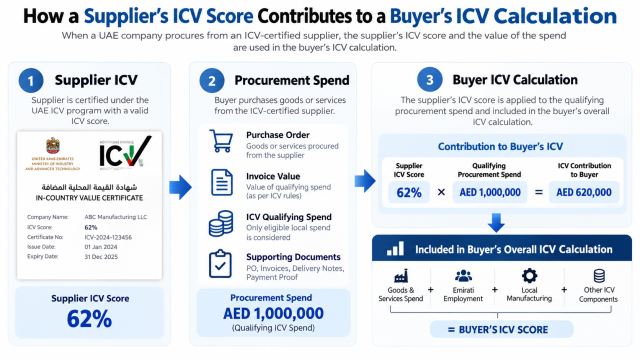
The part most buyers miss: supplier ICV flows into your ICV
This is the point that changes procurement behaviour once it is understood. Your own ICV score is not calculated in isolation. Spend with UAE-based suppliers is treated differently from spend that leaves the country, and where your supplier holds a valid ICV certificate, that spend can be recognised more favourably within your own calculation.
In practical terms, a Tier 1 supplier bidding into a participating entity is usually required to declare an ICV score as part of tender evaluation. That supplier, in turn, has a direct interest in buying from ICV-certified Tier 2 suppliers, because uncertified spend is treated less generously in the formula. The effect cascades down the chain.
The practical consequence: every recurring supply category is an ICV lever.
Cleaning chemicals, tissue and dispenser consumables, waste management equipment and janitorial supplies are bought month after month, year after year.
Consolidating that spend with an ICV-certified UAE supplier is one of the least disruptive ways to improve a score, because nothing about the operation has to change.
Where ICV appears in tender evaluation
Participating entities apply an ICV weighting within the commercial evaluation of a bid. The weighting is set by the entity rather than being uniform across the programme, so it varies by organisation and by tender. What is consistent is the direction of travel: a higher ICV score improves a bidder’s evaluated position against competitors with comparable technical and commercial submissions.
For bid teams, the implication is that ICV is a planning item, not a submission item. A certificate obtained two weeks before a tender closes reflects last financial year’s procurement decisions. Improving a score means changing sourcing decisions well in advance.
What to request from a supplier before you award
A surprising number of ICV submissions are weakened by supplier documentation that is technically valid but does not match the entity being invoiced. Before awarding a supply contract, request and check:
- A copy of the current ICV certificate, not a claim on a website or in a company profile.
- The exact legal entity name on the certificate, and confirmation that it matches the entity that will issue your invoices. Certificates are issued per legal entity, so a sister company’s certificate does not transfer.
- The financial year the certificate relates to and its validity period. Certificates lapse, and an expired certificate supports nothing.
- The name of the MoIAT-empanelled certifying body that issued it.
- The emirate the certificate was issued for, where your entity’s requirements are emirate-specific.
- Whether the supplier expects a material change in score at the next certification, if you are contracting for multiple years.
Common mistakes procurement teams make
- Treating ICV as a document-collection task at bid stage rather than a sourcing strategy through the year.
- Accepting a supplier’s verbal claim of certification without sighting the certificate.
- Filing a certificate at onboarding and never checking whether it has since expired.
- Focusing exclusively on large capital categories while ignoring the recurring consumable spend that accumulates quietly across a year.
- Assuming a UAE trade licence and an ICV certificate are the same thing. They are not the first proves registration, the second is an audited measure of economic contribution.
A short pre-award checklist
- Certificate sighted and on file, with expiry date diarised.
- Legal entity on certificate matches the invoicing entity.
- Certifying body confirmed as MoIAT-empanelled.
- Supplier’s UAE stockholding and delivery capability verified, not just their paperwork.
- Recurring consumable categories reviewed for ICV consolidation opportunities.
Working with an ICV-certified supply partner
Daitona General Trading LLC has supplied cleaning products, machines and janitorial equipment across the UAE since 1990 and holds both UAE ICV certification and ISO 9001:2015 certification. For procurement teams consolidating janitorial and hygiene spend with an eye on their own ICV position, documentation is available on request at onboarding and at each renewal.
Contact our team to request current certification documents or to review your recurring consumable spend.
Frequently Asked Questions
What is an ICV certificate in the UAE?
An ICV certificate is a document issued under the UAE's National In-Country Value Programme by a certifying body empanelled by the Ministry of Industry and Advanced Technology. It states, as a percentage, how much economic value a company adds within the UAE, based on audited financial statements covering local procurement, in-country investment, Emiratisation and expatriate workforce contribution.
Is ICV certification mandatory in the UAE?
ICV certification is not a general legal requirement for operating in the UAE. It becomes effectively necessary for companies that want to supply government and semi-government entities participating in the programme, because ICV carries a weighting in tender evaluation and suppliers are commonly asked to declare a score.
Does buying from an ICV-certified supplier improve my company's ICV score?
It can. Spend with UAE-based suppliers is treated differently from spend that leaves the country, and spend with certified suppliers is recognised more favourably within the calculation than uncertified spend. This is why Tier 1 suppliers frequently ask their own suppliers for ICV certificates. Your certifying body can confirm exactly how your specific spend is treated.
How long is an ICV certificate valid?
An ICV certificate relates to a specific financial year and carries a defined validity period, after which the company must be re-certified against fresh audited financial statements. Buyers should record expiry dates at onboarding and request updated certificates at renewal rather than assuming a certificate on file is still current.
Is an ICV certificate the same as a trade licence?
No. A trade licence confirms that a company is legally registered to operate in a given emirate. An ICV certificate is an audited assessment of how much value that company adds to the UAE economy, expressed as a score, and is used in tender evaluation by participating entities.