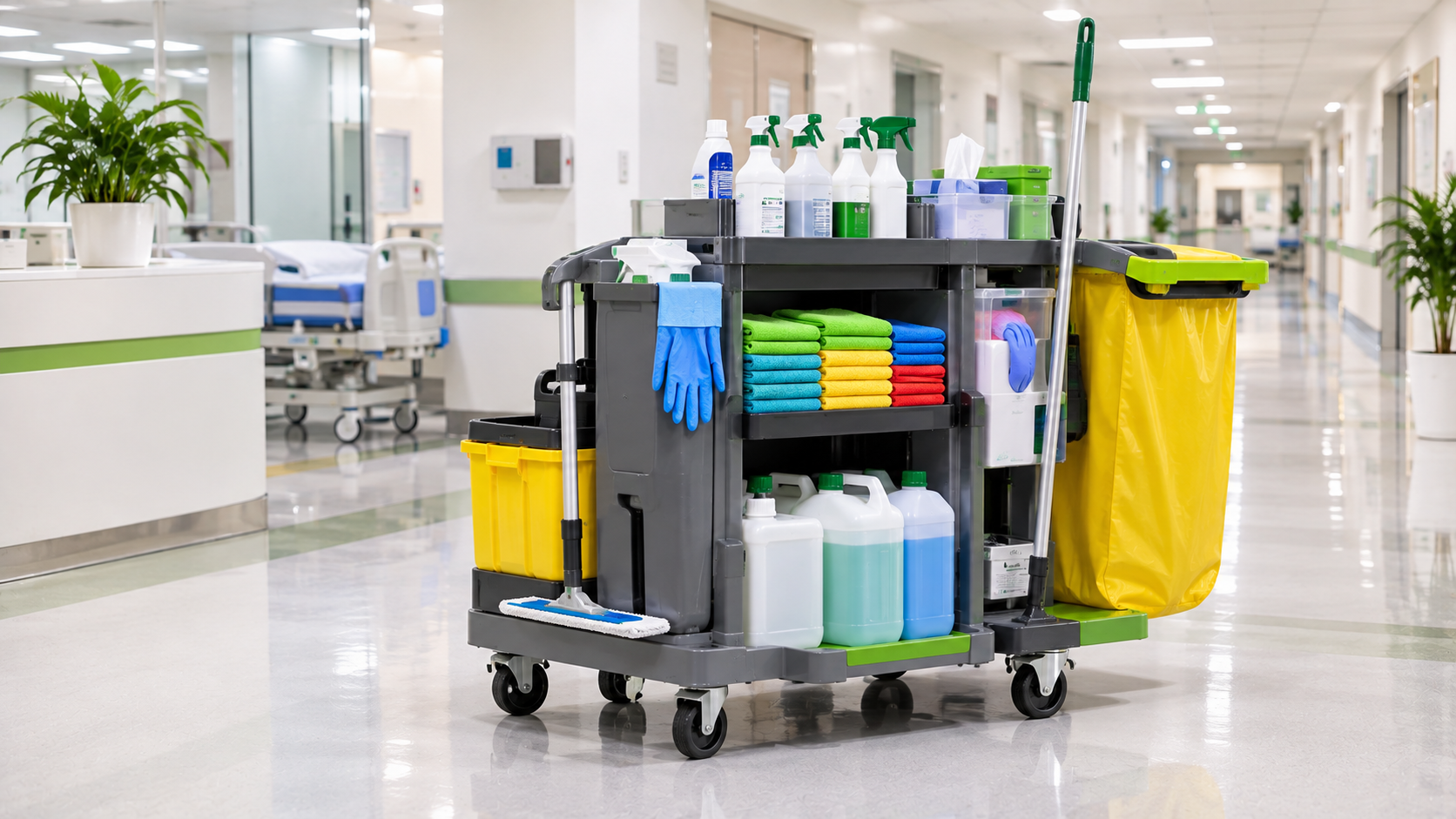
Buying cleaning supplies in the UAE for a hospital or clinic is not a harder version of buying them for an office. It is a different exercise, because the supply list is part of the facility’s infection prevention and control system and is inspected as such. A product that works perfectly well in a hotel corridor can fail a licensing inspection in a treatment room.
This guide is for procurement managers, practice managers and facility management contractors buying cleaning supplies for DHA, DoH and MOHAP-licensed facilities across the UAE what the supply list has to achieve, and what evidence has to sit behind it.
Start by zoning the facility by risk
A healthcare supply list is built by risk zone, not by room count. Working from highest to lowest:
| Risk level | Typical areas | What it drives |
|---|---|---|
| High | Operating theatres, procedure rooms, treatment rooms, isolation, laboratories, sterile services | Dedicated equipment and textiles, documented disinfection, highest-specification disinfectant, strict segregation |
| Moderate | Consultation rooms, wards, day care, imaging, phlebotomy | Routine clean plus disinfection of high-touch surfaces, colour-coded sets, documented frequency |
| Low | Reception, waiting areas, corridors, offices, staff rooms | Routine cleaning with a neutral cleaner, high-touch disinfection, standard colour coding |
| Support | Kitchens, washrooms, waste rooms, plant rooms | Food-safe or sanitary-specific products, fully separate equipment |
The critical principle is that nothing crosses between zones. Cloths, mops, buckets, brushes and in high-risk areas machines are dedicated to their zone and do not travel. That requirement sets the quantity of textiles and equipment you need to buy, which is usually more than a first-pass supply list allows for.
Clean before you disinfect
The foundational principle in healthcare environmental cleaning, and the one most often lost in practice: disinfection does not compensate for inadequate cleaning. Soil physically shields micro-organisms from the disinfectant. DHA’s clinical infection control guidance states the principle directly cleaning is the step that makes disinfection possible, and skipping it makes the disinfection step largely ineffective.
For procurement, this means the supply list needs both: a cleaner to remove soil and a disinfectant to reduce microbial load, plus enough cloths to do it in two stages without re-using a contaminated cloth. A single “cleaner-disinfectant” product does not remove the need for the mechanical cleaning step.
Disinfectant selection and contact time
Contact time is the specification detail that decides whether the money spent on disinfectant achieves anything. A disinfectant must remain visibly wet on the surface for the period stated on its label. Applied and wiped off immediately, it has cleaned the surface and done little more.
When specifying disinfectants for a UAE healthcare facility, establish for each product:
The stated contact time, and whether the surface will realistically stay wet that long in an air-conditioned room.
The level of disinfection it provides low, intermediate or high and whether that matches the item and the zone. Non-critical items that touch intact skin generally require cleaning and low to intermediate-level disinfection between patients; semi-critical and critical items follow the manufacturer’s instructions for high-level disinfection or sterilisation.
Material compatibility with the surfaces and medical equipment it will be used on, confirmed against the device manufacturer’s instructions for use. Disinfectant damage to equipment housings is a common and expensive error.
Whether the product is registered for sale in the emirate, and whether its claims are supported by test data you can be shown.
Dilution ratio and whether it is supplied ready-to-use or as a concentrate requiring dosing control.
A practical rule: do not disinfect what you can sterilise. For reusable instruments, sterilisation is the standard; disinfection is for surfaces and items that cannot be sterilised.
High-touch surfaces
High-touch surfaces carry disproportionate transmission risk and need disinfection at a defined frequency, not when they look dirty. The list in a typical clinic includes door handles and push plates, bed rails, light switches, call buttons, taps and sanitary fittings, chair arms in waiting areas, reception counters, keyboards and card terminals, handrails, lift buttons, and the shared equipment surfaces in treatment rooms.
For procurement, the implication is volume: high-touch disinfection at frequency consumes far more wipes, cloths and disinfectant than a standard commercial list assumes. Build the consumption estimate from the frequency in your cleaning schedule rather than from a comparable square-metre figure for an office.
Colour coding
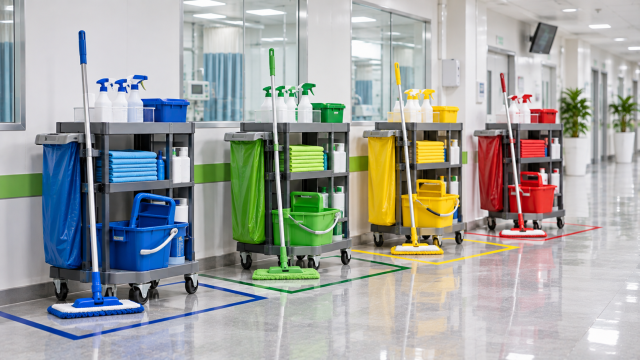
A four-colour system is the convention across UAE hospitality and facility management: red for sanitary areas, yellow for other washroom surfaces, blue for general and public areas, and green for kitchens and food handling. Healthcare facilities commonly extend it with a dedicated colour or a fully separate set for clinical areas.
Two procurement points. First, decide the system before you order cloths, mops, buckets, brushes and trolleys retrofitting colour coding onto stock already purchased costs far more than specifying it at the outset. Second, buy enough of each colour that staff are never short and improvising, because a shortage of the right colour is how cross-contamination actually happens. Display the colour chart in the store and in every cleaning cupboard, in the languages your team reads.
Waste segregation and the supplies it requires
Medical waste segregation happens at the point of generation, and the facility remains responsible for correct segregation and storage until an approved contractor collects it. Getting the consumables right is a procurement decision with licensing consequences.
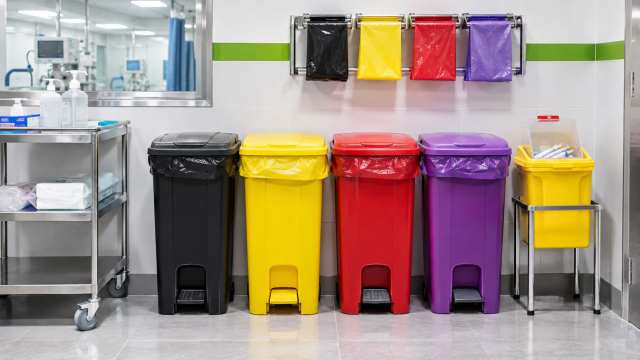
The Department of Health Abu Dhabi’s Medical Waste Management Standard for Healthcare Facilities sets out colour-coded segregation for DoH-licensed facilities, broadly:
| Stream | Colour | Contents |
|---|---|---|
| General waste | Black | Non-hazardous general and wet food waste |
| Medical and sharps waste | Yellow | Clinical waste from patient care; sharps in rigid puncture-proof containers |
| Pathological and anatomical | Red | Anatomical waste and waste from isolation rooms |
| Cytotoxic and cytostatic | Purple | Chemotherapy agents and anything they have contacted |
The standard also specifies bag gauge by stream medium-duty for general medical waste and heavy-duty for cytotoxic and a fill limit of around 65% so bags can be closed and handled safely.
Colour conventions are not identical across the UAE. Practice has historically differed between emirates, and requirements are set by the local health authority and municipality. Confirm the scheme that applies to your facility with your own licensing authority DHA, DoH or MOHAP and your municipality before standardising a bulk order. Buying twelve months of the wrong colour is an expensive way to learn this.
What the waste stream requires you to buy:
Colour-coded bags in the correct gauge and dimension for each stream and each bin, with biohazard marking where required.
Rigid, puncture-proof sharps containers, replaced at the stated fill level commonly three-quarters full rather than when full.
Foot-operated, lidded bins in clinical areas so no hand contact is needed.
Bins sized and placed at the point of generation, in every treatment, procedure and examination room.
Clear labelling and signage for each stream, bilingual.
Ties or closures matched to the stream.
Specify bags against the bin dimensions and the stream, not by price per roll. A clinical waste bag that splits is an incident, not an inconvenience.
Hand hygiene and PPE
Hand hygiene consumables are the highest-consumption category in a healthcare facility and the one where a run-out has the most direct clinical consequence. Specify dispensers and refills as a matched system, confirm compatibility before buying either, and set the deepest par level of any category against them.
The list covers hand soap and dispensers, alcohol-based hand rub at point of care as well as at entrances, hand towel and dispensers, gloves in the sizes and materials your clinical staff actually use, aprons and gowns, eye protection, and masks to the specification your facility requires. PPE must be matched to the chemicals held as well as to clinical risk the gloves suitable for patient contact are not necessarily rated for handling a concentrated disinfectant.
Documentation and audit evidence
DHA licensing standards require health facilities to operate infection control measures covering environmental infection control, hazardous waste management and evidence of staff training. In practice, inspections look for documentation as much as for a clean building. The supply-side evidence worth holding:
A current safety data sheet for every chemical in use, accessible where it is used.
Product registration references for disinfectants and detergents, matched to the invoicing entity.
Cleaning schedules by zone, stating product, dilution, frequency and contact time.
A colour-coding chart displayed in the store and each cleaning cupboard.
Training records for cleaning staff on dilution, contact time and zone discipline, updated as staff turn over.
A current contract with an approved medical waste contractor, and waste transfer records for every collection.
If your supplier cannot produce documentation for what they sell you, that gap becomes your finding at the next inspection.
What to require of a supplier
Beyond the general nine questions to ask a janitorial supplier, a healthcare buyer should add:
Product registration documentation for every disinfectant and detergent supplied.
Safety data sheets provided as standard at onboarding and re-issued on reformulation.
Written notice before any product is reformulated or discontinued an unannounced substitution in a facility running documented cleaning procedures is a compliance problem, not an inconvenience.
Confirmed local stock on hand hygiene consumables and clinical waste bags, which cannot run out.
Operator training support, and refresher training as staff turn over.
The ability to supply the full list chemicals, textiles, waste consumables, hand hygiene, dispensers and machine consumables on one account, so that dispenser and refill compatibility is the supplier’s problem rather than yours.
Building a healthcare supply list
Daitona General Trading LLC has supplied cleaning products, machines and janitorial equipment across the UAE since 1990, including to hospitals and healthcare facilities, and holds both UAE ICV certification and ISO 9001:2015 certification. We hold stock locally, deliver from Dubai and Abu Dhabi, and cover cleaning chemicals, commercial janitorial supplies, dispensers, aerosol and tissue and waste management on a single account.
Please note: this guide is written for procurement planning. Disinfectant selection, cleaning frequencies and waste handling in a licensed healthcare facility are clinical and regulatory decisions that should be set by your infection prevention and control team against the current requirements of your licensing authority.
Contact our team with your facility’s zone map and cleaning schedule and we will build a costed supply schedule.
Frequently Asked Questions
What cleaning supplies does a hospital need in the UAE?
A healthcare supply list is built by risk zone and covers: cleaners and disinfectants specified per zone, colour-coded cloths, mops, buckets and trolleys dedicated per zone, hand hygiene consumables and matched dispensers, PPE matched to both clinical risk and the chemicals held, colour-coded clinical waste bags and rigid sharps containers, foot-operated lidded bins at the point of generation, and floor care equipment that can be cleaned down between zones.
What are the colour codes for medical waste in the UAE?
Under the Department of Health Abu Dhabi medical waste standard, black is general waste, yellow is medical and sharps waste, red is pathological and anatomical waste including waste from isolation rooms, and purple is cytotoxic and cytostatic waste. Conventions have historically varied between emirates, so confirm the scheme that applies to your facility with your licensing authority and municipality before standardising a bulk order.
How often should high-touch surfaces be disinfected in a clinic?
At a frequency set in the cleaning schedule rather than when surfaces look soiled, with the frequency determined by the risk level of the zone and your infection prevention and control policy. The procurement implication is volume: high-touch disinfection at frequency consumes considerably more wipes, cloths and disinfectant than an equivalent office specification.
Does disinfectant need a contact time?
Yes. A disinfectant only works if it stays visibly wet on the surface for the contact time stated on its label. Applying and wiping it off immediately cleans the surface but achieves little disinfection. Check the stated contact time, confirm the surface will stay wet that long in air-conditioned conditions, and build the time into the cleaning procedure.
Is cleaning the same as disinfecting in a healthcare facility?
No, and the order matters. Cleaning physically removes soil; disinfection reduces the microbial load on an already-clean surface. Soil shields micro-organisms from disinfectant, so disinfection does not compensate for inadequate cleaning. A healthcare supply list needs both products and enough cloths to do it in two stages.
Do hospitals and clinics in Dubai need DHA-approved cleaning supplies?
DHA licenses facilities rather than approving individual cleaning products. What the standards require is that the facility operates infection control covering environmental cleaning, hazardous waste management and staff training, with documentation available at inspection. Separately, detergents and disinfectants must be registered with the municipality to be sold in the emirate. In practice, buyers should hold registration references and safety data sheets for every product and align cleaning schedules to their IPC policy.