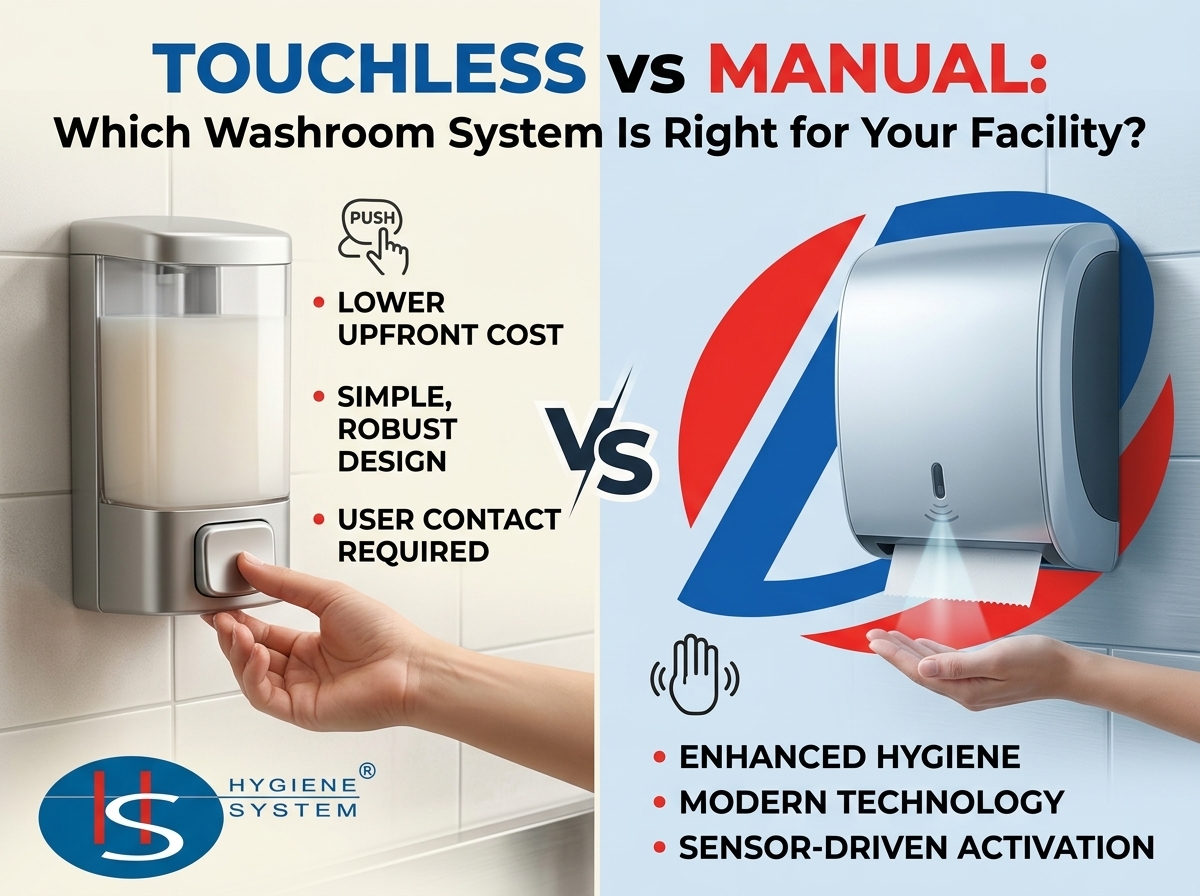
For most UAE facilities with moderate to heavy foot traffic, touchless dispensers are the better choice. They cut cross-contamination at the point where most people actually touch a washroom, reduce complaints about empty soap or paper, and hold up better under hotel, retail, or industrial-scale use. Manual dispensers still make sense in low-traffic back-of-house areas, storerooms, or budget-constrained fit-outs, where the higher upfront cost of touchless hardware is harder to justify. The right answer depends on footfall, budget, and how much staff time you have for restocking and battery changes.
In this article
- What is the real difference between a touchless and a manual dispenser?
- Which is more hygienic, touchless or manual?
- How much more does a touchless system cost to run?
- Which type of facility should choose touchless dispensers?
- What else should a washroom hygiene program include?
- How do you switch from manual to touchless without disrupting operations?
- FAQ
What Is the Real Difference Between a Touchless and a Manual Dispenser?
A manual dispenser releases product when someone presses a lever or pump. It needs no batteries, costs less to buy, and is simple for any technician to service. A touchless dispenser uses an infrared sensor to release a measured dose when a hand passes underneath, so nobody has to grip a handle that hundreds of other hands have already touched that day.
The mechanism matters more than it sounds. In a busy hotel lobby restroom or a factory changing room, a manual pump becomes one of the highest-touch surfaces in the building within the first hour of the shift. A touchless unit removes that surface from the equation entirely.
Which Is More Hygienic, Touchless or Manual?
Touchless wins on hygiene in any washroom with meaningful footfall. Independent facility hygiene guidance consistently flags high-touch points, door handles, taps, and dispenser pumps, as the surfaces that need the most frequent disinfection precisely because so many hands land on them between cleaning rounds. Removing the pump removes one of those points.
Touchless dispensers also dose more consistently. A worn manual pump can under-deliver or over-deliver product depending on wear, while a sensor-triggered unit releases the same amount every time, which keeps consumable use predictable and avoids the “empty by lunchtime” complaint that drives most washroom tickets.
How Much More Does a Touchless System Cost to Run?
Touchless units cost more upfront and need periodic battery changes, roughly every 3 to 6 months on a busy unit. Manual units cost less to buy and never need power, but they wear out faster mechanically and are more likely to jam or leak once the pump seal degrades. The table below breaks down the practical trade-offs facility managers weigh most often.
| Factor | Touchless | Manual |
|---|---|---|
| Hygiene | No shared touch point | Pump is a high-touch surface |
| Upfront cost | Higher | Lower |
| Running cost | Batteries every 3 to 6 months | None, refills only |
| Dosing consistency | Fixed dose every time | Varies as the pump wears |
| Maintenance | Sensor cleaning, battery swaps | Pump seal replacement over time |
| Best for | Hotels, malls, hospitals, factories | Storerooms, low-traffic back-of-house |
Which Type of Facility Should Choose Touchless Dispensers?
Any washroom that a guest, customer, or more than roughly 20 to 30 staff pass through daily justifies touchless hardware. That covers hotel guest and lobby restrooms, retail and mall washrooms, hospital and clinic bathrooms, and factory or warehouse changing rooms where large shift changeovers create heavy short-burst traffic.

AZ Hygiene Auto Liquid Hand Soap Dispenser, 900ml
Sensor-triggered dosing, dual refill system (bulk bottle or cartridge), built for high-footfall washrooms.
What Else Should a Washroom Hygiene Program Include Beyond Soap?
Soap gets most of the attention, but odor control shapes how clean a washroom feels the moment someone walks in, and it is one of the most common complaints facility teams field from guests and staff. A consistent, automated air freshener program removes the guesswork of manual spraying, which tends to happen inconsistently or not at all during busy shifts.

AZ Hygiene Automatic Air Freshener Dispenser
Programmable timed spray intervals for consistent odor control in washrooms, offices, and back-of-house corridors.
How Do You Switch an Existing Washroom from Manual to Touchless Without Disrupting Operations?
Replace one washroom or floor at a time rather than the whole building at once. Start with the highest-traffic restroom, typically the lobby or ground floor, so the upgrade is visible where it matters most and any install issues surface on a small scale first. Keep manual units as backup stock during the transition period, since a dead battery on a newly installed touchless unit with no manual fallback is the most common complaint in the first month. Brief cleaning staff on the new battery change schedule before go-live so restocking rounds do not miss it.
Frequently Asked Questions
Do touchless dispensers work during a power cut?
Yes. Touchless dispensers run on internal batteries rather than mains power, so they keep working normally during a facility-wide power outage as long as the batteries have charge.
How often do touchless dispenser batteries need replacing?
Most units need a battery change every 3 to 6 months on high-traffic washrooms, and less often on lower-traffic units. Build it into the same restocking schedule as soap refills so nobody forgets.
Can manual and touchless dispensers use the same soap refill?
It depends on the model. Some ranges share a bulk refill bottle across manual and touchless housings, which simplifies stock, while others need a dedicated cartridge. Check compatibility before standardizing across a building.
Is a touchless dispenser worth it for a small back-office washroom?
Usually not. Low-traffic washrooms with fewer than a handful of daily users rarely see enough benefit to justify the extra cost and battery upkeep. A manual dispenser is the more practical choice there.
Do touchless dispensers reduce soap waste?
Generally yes, because the fixed dose per trigger avoids the over-pumping that happens with a worn manual lever, which tends to reduce consumable cost per wash over time.
Planning a Washroom Upgrade Across Multiple Sites?
Daitona supplies dispensers, consumables, and cleaning equipment to facility teams across the UAE, with trade pricing for bulk orders.
Browse Washroom Hygiene Products →
Contact Daitona for a trade quote on multi-site orders.